


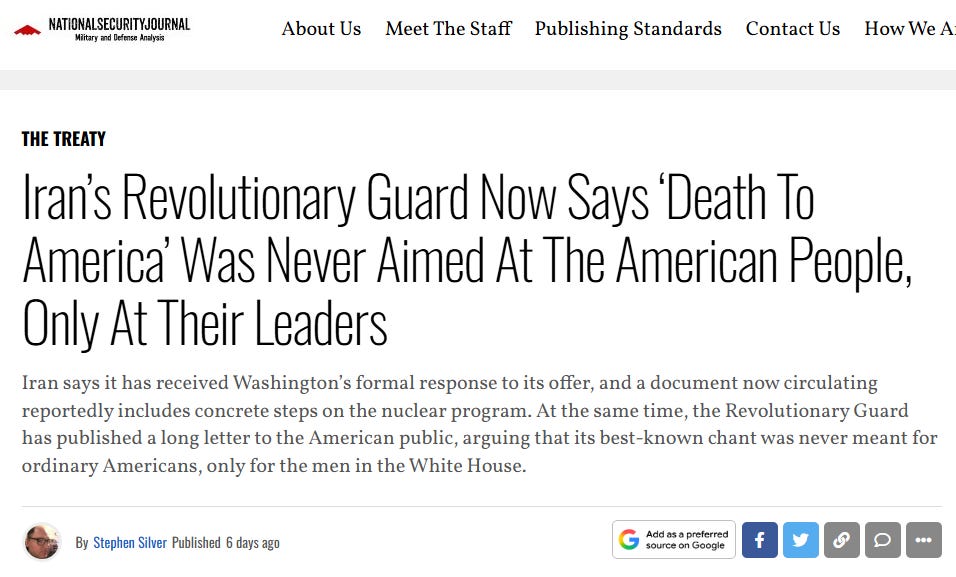
Number 4. National Security Journal. Death to America does not really mean Death to America.
This gives “spin” a bad name.
In an open letter to “the American public,” the Iranian Revolutionary Guard Corps (IRGC) assures readers that “Death to America!” in no way expresses hope that America might die.
Only that its leaders do so.
IRGC appealed to “scholars, students and media” to persuade evil and misguided occupants of the White House to pull military forces back from the Middle East and sever ties with Israel. Only then, the letter asserts, can there be peace.
Although the chant “Death to America!” has been the rallying cry since 1979, when the Shah was deposed, it has never really meant what the words suggest. It is more a condemnation of those who lead America.
In that sense, the IRGC is a remarkably equal-opportunity adversary. Presidents since the ascension of the current Iranian regime have been Carter, Reagan, Bush, Clinton, Bush, Obama, Trump, Biden and Trump: party affiliation D,R,R,D,R,D,R,D,R. Four Democrats, five Republicans.
Maybe in Farsi the Death to America thing alliterates well, or rhymes mellifluously, such that some Islamic poetic license allows it to be understood in some sense other than literal.
Just think: After all these years, us unenlightened American hicks really thunk they were out to kill us. What a relief to know it was merely a friendly suggestion to re-think our politics.
A suggestion, that is, punctuated with a few actual killings of Americans by Iran, their proxies, or others with documented Iranian assistance, such as: Marine barracks, Beirut, 1983; US Embassy bombing, Beirut, 1983; Khobar Towers, Saudi Arabia, 1996; Twin Towers/Pentagon, 2001; Militia attacks during Iraq war, 2003-2011; Karbala raid, Iraq, 2007; Drone attack, Syria, 2023; Tower 22 drone attack, Jordan, 2024. (Source: ChatGPT. Accept it or not, but every entry came with a clickable citation.)
No intentional death to ordinary Americans here at all, I’m pretty sure.

It sort of puts me in mind of Inigo Montoya (1987): “I do not think that word means what you think it means.”
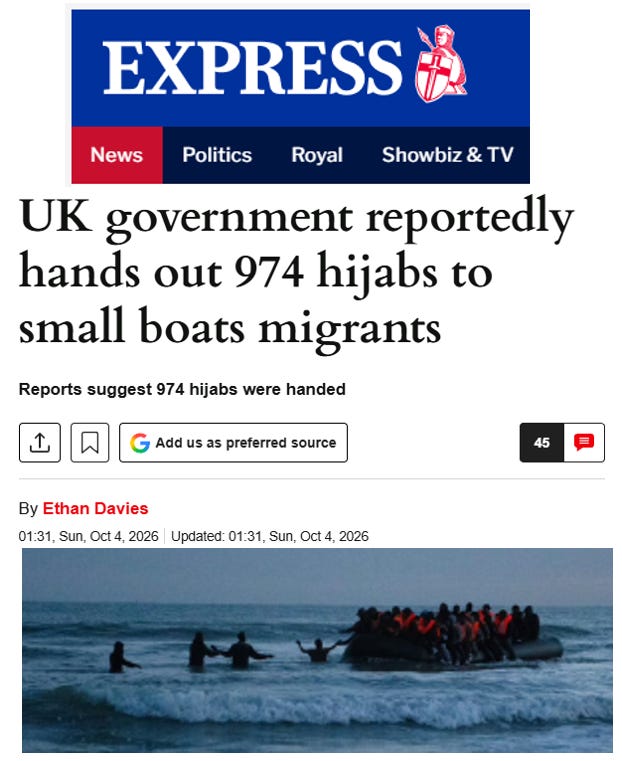
The United Kingdom has encoded their well-known generosity into clear public policy. A current population of 60-some million in the British Isles has been bolstered by over two million immigrants since 2023.
It seems that many of these new arrivals, from more southerly and warmer climes, have recently been coming by boat. Not ship… boat. Such as inflatables launched across the Channel with dozens of drenched people hanging on.
When they arrive, they are understandably hungry, exhausted and wet.
It is the formal policy of Great Britain to give persons in such distress a care package consisting in part of dry clothing.
Somewhere along the line, it became clear that these new arrivals were generally not practicing Anglicans. The women, to be faithful to the religion of their origin, required a head covering. I suppose that means the one they left France with did not survive the Channel journey.
The UK gift baskets are for men, women and children, and include track suits to provide warm and dry clothing. The women’s packages also include a hijab, so that they can practice their religion faithfully.
Only a thoughtless boor would observe that their religion does NOT extend to urging adherents NOT to take over a country far away.
At any rate, Britain codified the gift baskets into routine practice. By now, British taxpayers have generously donated 974 hijabs to recent arrivals.
I am sure the local populace takes pride in seeing their gifts so graciously received, except that a recent crackdown by the Hampshire Constabulary ordered residents of the port town of Gosport to remain indoors during the anticipated arrival of the most recent boat wave.
Gosportians were forcibly locked down by their own police, not allowed near the wharf, lest the newcomers get the idea they were somehow not welcome.
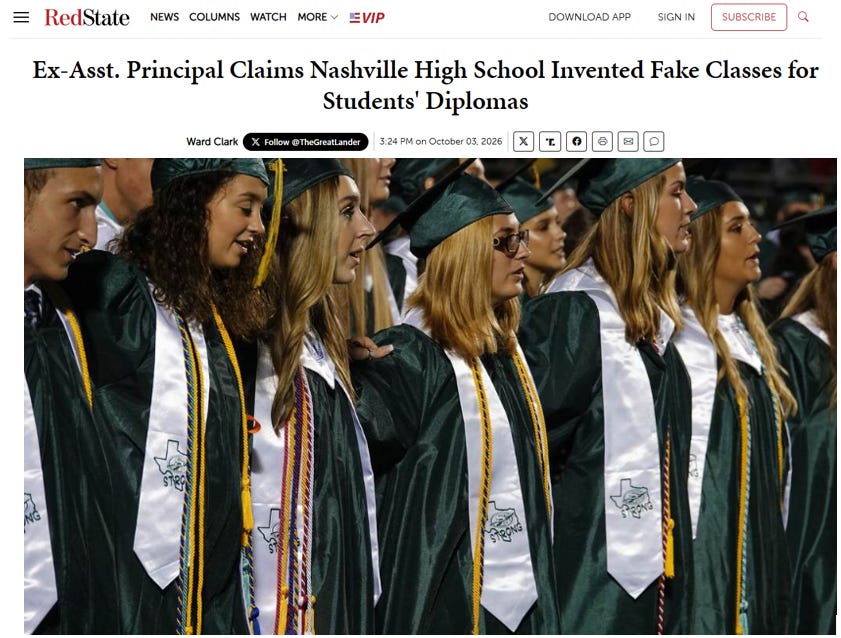
Number 2. RedState. Tennessee high school enrolls students in fake classes to assure graduation.
This is one of those unique heart-warming stories of strong men ensuring that less advantaged youngsters be able to succeed.
At any cost.
Stratford High School in Nashville, Tennessee, noted a serious problem with student achievement. Despite four years of careful management and hard work on the part of students (“Hard work…” Yeah, I have borrowed some literary license from the “Death to America does not mean what it says” notion) it seems that some seniors lacked adequate credits. They would not be able to meet the state’s requirements, and thus would receive no diploma.
The Volunteer State rose to the challenge. In the finest tradition of overcoming adversity through creativity, Stratford administrators came up with an ingenious solution.
Follow this closely. (At no time will my fingers ever leave my hands.)
Their last semester, about-to-fail students were allowed to enroll in a class that was not offered. Call it “Underwater cross-cultural basket-weaving.” The article does not specify which class was in question.
Because there was no class and no instructor, students were unable to turn in work sufficient to earn a grade in the non-existent course offering. Therefore, they flunked out of basket-weaving.
That was the opening move.
A program called Edgenuity appeared. Edgenuity is an online system where students who have failed to pass a class can take a test over the course material. If they pass the test, they can receive a passing grade.
To pass the course which was not offered, the students needed some personal tutoring from the teacher who did not teach it. Assistance was provided in the form of an unoccupied teacher who apparently sat with the student during the online fill-in-the-blank test and provided… counseling… as required.
Voila! Students passed the test over material that had not been assigned, received credit in a course that had not been listed, and were able to graduate on time.
A fake class was passed with a fake test, so that fake students could receive a fake diploma. And thus take their place in a productive though perplexing society where they will presumably find real employment.
If their luck holds, they might get a job in sales, where the chimera of need is satisfied by the artifice of value—for a modest monthly subscription. First month free.
Number 1. Moneywise. Small boats abandoned in harbors on West Coast due to high costs.
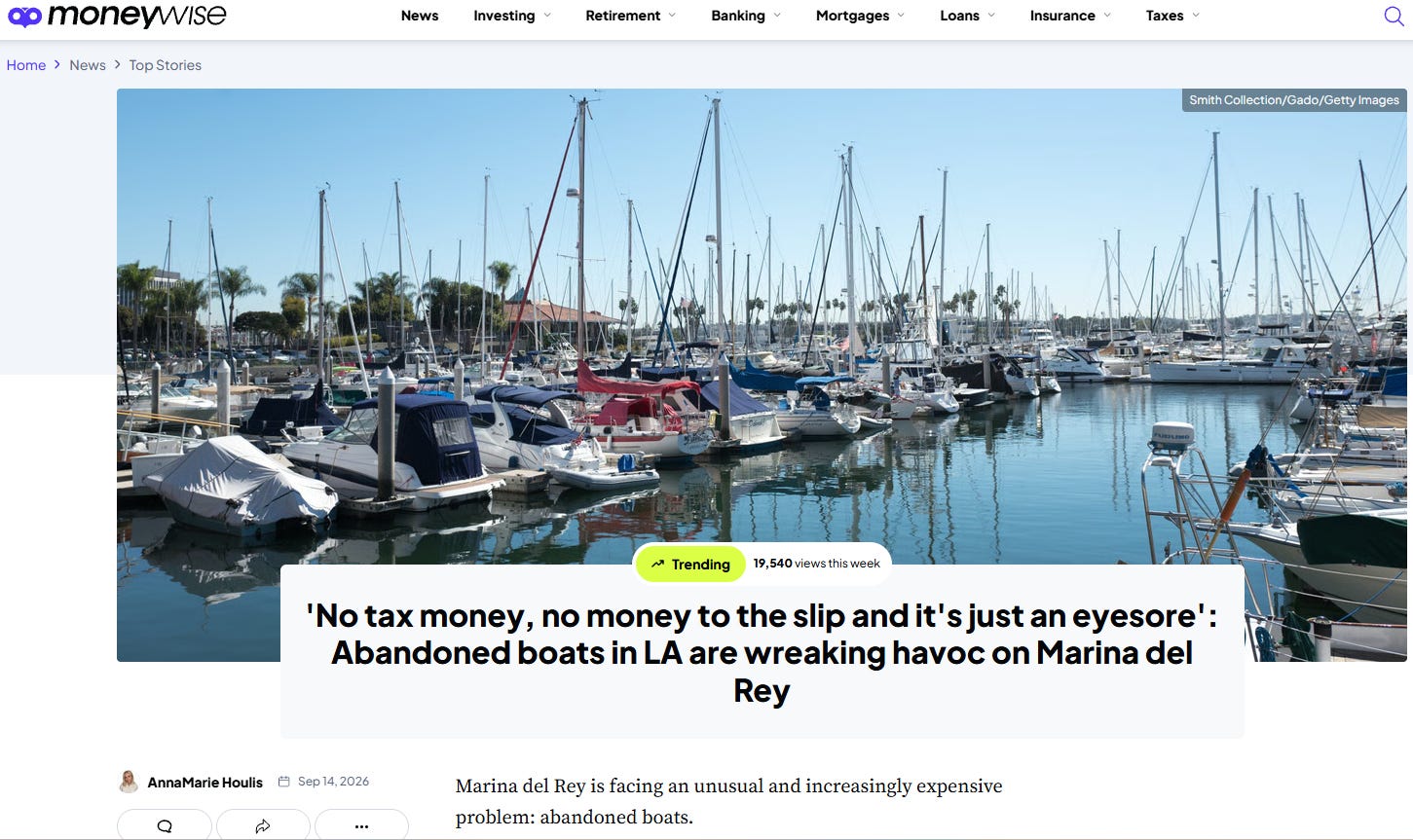
For many Californios, that new sailboat had all the attraction of the dream timeshare. Now, with maintenance, barnacles, dock fees, insurance and luxury taxes, it has turned into a budgetary nightmare.
There was a time when buying a sailboat meant freedom. Standing at the wheel, salt spray in your face, leaning into the wind, attractive spouse beside you, the Pacific stretching endlessly toward Hawaii.
Now you stand in the marina office arguing with a salaried bureaucrat about a slip fee while something green and possibly sentient grows on the bottom of your boat.
Currently in Marina del Rey, 100 boats are in various stages of abandonment. Thirty more join the fleet every year. Some owners have discovered a fundamental principle of nautical economics: The boat costs money even when you stop liking boats.
Unpaid dock fees can soon exceed the value of the asset.
This leads the financially sophisticated yachtsman to the time-honored California solution for an insoluble problem: Walk away and let the taxpayers figure it out.
This works well for the former boat owner and his attorney; somewhat less so for the marina.
Abandoned vessels now remain tied to docks, deteriorating ungracefully, transitioning inexorably from private recreational asset to public environmental concern.
California, fortunately—and predictably—has a government program for this. The Surrendered and Abandoned Vessel Exchange program—SAVE—provides money to dispose of unwanted boats. Los Angeles County received $80,000 from the program two years ago. Last year it received $44,000.
At prices approaching $50,000 to dispose of one boat, I think I have identified a potential weakness in the business model. Besides that, there is only one authorized vendor presently removing boats from Marina del Rey. He has a guaranteed career.
Thus, California has achieved a perpetual closed-loop economy: A citizen buys something he cannot afford and abandons it; government resolves to remove it but lacks funding; the boat remains where it is.
This is a creative twist on sustainability, courtesy of the Left Coast.
Perhaps the state could solve the problem by converting the abandoned boats into affordable housing.
Don’t laugh. That scratching sound you just heard was somebody in Sacramento writing it down.
And thanks for joining The Alligator News Roundup for Friday, October 9, 2026. It is always good to have a young grandchild in the house for a week. Someone here thought it clever to purchase a 1,000-piece jigsaw puzzle we could work on together—and which now threatens to transform a scene of pleasant inter-generational cooperation into an obsessive confrontation over what time bedtime is.
But I really wouldn’t have it any other way.
Have a good weekend!


